Previous Symposia: 2025 2024, 2023, 2022, 2021

SPSC Symposium and VPC Challenge
6th Symposium on Security and Privacy in Speech Communication joined with 4th VPC Challenge
Speech and voice are media through which we express ourselves. Speech communication can be used to command virtual assistants, to transport emotion or to identify oneself. How can we strengthen security and privacy for speech representation types in user-centric human/machine interaction?
Interdisciplinary exchange is in high demand. The need to better understand and develop user-centric security solutions and privacy safeguard in speech communication is of growing importance for commercial, forensic, and government applications. The SPSC Symposium is a platform to seek better designed services and products as well as better informed policy papers for legislators and governance. The symposium is organized by the ISCA SPSC special interest group and the VPC Challenge Organizers.
Submission now open
Last year's Proceedings
The proceedings are available via the ISCA Archive.
The 6th edition of the Symposium on Security & Privacy in Speech Communication focuses on speech and voice as central media through which humans convey intentions, emotions, and identity in both everyday and professional contexts. Spoken interaction now underpins virtual assistants, biometric services, and sensitive applications in sectors such as healthcare, forensics, and commerce. The symposium invites contributions that address how we can strengthen security and privacy for diverse speech representation types in user-centric human–machine interaction, while preserving usability and trust. To this end, it fosters interdisciplinary exchange and aims to bring together researchers and practitioners from multiple fields, including signal processing, cryptography, security, human–computer interaction, law, ethics, and anthropology. This symposium continues the successful series of events stemming from the ISCA special interest group on Security & Privacy in Speech Communication (SPSC-SIG), where perspectives from technological and humanities communities mutually inform and enrich one another to develop multidisciplinary and interdisciplinary skills.
For the general symposium, we welcome contributions on related topics, as well as progress reports, project dissemination, theoretical discussions, and “work in progress”. In addition, guests from academia, industry, and public institutions, as well as interested students, are welcome to attend the conference without submitting their own contribution. Building on community efforts such as the VoicePrivacy Challenge and related benchmarks, the symposium explicitly welcomes VoicePrivacy 2026 Challenge participants to submit papers related to their challenge contributions and broader work on voice privacy and speaker anonymization. While we aim to meet all participants on-site, virtual presentations will also be possible during the symposium. More details regarding the challenge can be found at VPC Challenge Webside.
Call for Papers
The Symposium aims at laying the first building blocks required to address the question of how researchers and practitioners might bridge the gap between social perceptions and their technical counterparts with respect to what it means for our voices and speech to be secure and private. The symposium brings together researchers and practitioners across multiple disciplines – more specifically: signal processing, cryptography, security, human-computer interaction, law, and anthropology. By integrating different disciplinary perspectives on speech-enabled technology and applications, the SPSC Symposium opens opportunities to collect and merge input regarding technical and social practices, as well as a deeper understanding of the situated ethics at play.
The SPSC Symposium addresses interdisciplinary topics.
For more details, see Full CFP
SPSC Topics regarding the technical perspective and the humanities view include, but are not limited to:
- Speech Communication on the sense of security and privacy
- Cybersecurity for speech processing
- Machine Learning to increase security and privacy
- Natural Language Processing and privacy
- Human-Computer Interfaces (Speech as Medium)
- Ethics & Law
- Digital Humanities
Submission:
Papers intended for the SPSC Symposium should be up to eight pages of text. The length should be chosen appropriately to present the topic to an interdisciplinary community. Paper submissions must conform to the format defined in the paper preparation guidelines and as detailed in the author's kit. Papers must be submitted via the online paper submission system via the Link on the SPSC Website. The working language of the conference is English, and papers must be written in English. All accepted papers will be published in the ISCA archive alongside Interspeech papers and related ISCA workshops. The overleaf template can be found here or use the Overleaf Template.
Submission system is open:
Reviews:
At least three double-blind reviews are provided, and we aim to obtain feedback from interdisciplinary experts for each submission.
Program
We are glad to announce the preliminary program. All times are in Australian Eastern Standard Time (AEST) (UTC+10).
Saturday, September 26th 2026
| Time | Event |
|---|---|
| 09:00 - 09:30 | Welcome and Opening |
| 09:30 - 10:30 | SPSC Oral Session 1 – Voice Anonymization, Representation & Utility |
| 09:30 - 09:45 |
Goodbye Equal Error Rate, Hello Local Information Disclosure: Evaluating Voice Anonymisation against 1-to-N Linkage Threats Dāvis Šterns, Konstantinos Drossos, Natasha Fernandes, Tom Bäckström, Catuscia Palamidessi |
| 09:45 - 10:00 |
Prosodic Conditioning and Identity Leakage in Speaker Anonymization for Pathological Speech Yamini Sinha, Suhita Ghosh, Sebastian Stober, Ingo Siegert |
| 10:00 - 10:15 |
Evaluating Parkinson’s Disease Detection in Anonymized Speech: A Performance and Acoustic Analysis Carlos Franzreb, Francisco Teixeira, Ben Luks, Sebastian Möller, Alberto Abad |
| 10:15 - 10:30 |
In Defense of Using Worst-case Privacy Disclosure as Privacy Evaluation Metric of Voice Anonymization Xin Wang, Xiaoxiao Miao |
| 10:30 - 11:00 | Morning Coffee Break |
| 11:00 - 12:00 | SPSC Oral Session 2 – Privacy Threats, Evaluation & Longitudinal Effects |
| 11:00 - 11:15 |
Non-Uniform Privacy Leakage: Subgroup Disparities in Membership Inference Attacks on Speaker Recognition Systems Chenyi Lin, Tom Bäckström, Nicholas Evans, Khalid Choukri |
| 11:15 - 11:30 |
How Much Do Speaker Embeddings Age? Model-Dependent Longitudinal Drift Across Parliamentary and Web Speech Ingo Siegert, Yamini Sinha, Jan Marquenie |
| 11:30 - 11:45 |
Beyond the Signal: A Threat Model and Evaluation Lens for Privacy in Agentic Voice Assistants Hannaneh B. Pasandi Remote presentation |
| 11:45 - 12:00 |
Towards Interpretable Speaker Representations for Controllable Voice Privacy Protection Jiusi Zheng, Martha Larson, Tom Bäckström Remote presentation |
| 12:00 - 12:20 | VoicePrivacy Challenge 2026 – Overview, Results & Key Findings |
| 12:30 - 13:00 |
VPC Oral Session – Part 1 3 contributions, 7 min talk + 3 min Q&A each |
| 12:30 - 12:40 |
T3 Voicecode, VoxCPM2 Voice-Design Anonymization for VoicePrivacy 2026: English and Multilingual Systems Sheng Zhao, Yibo Duan, Zihan Chai, Xuyang Xing, Maquan Yang, Shengchen Li |
| 12:40 - 12:50 |
T15 ZZZ, Radboud-Aalto Submission to the Voice Privacy Challenge 2026 Jiusi Zheng, Martha Larson, Tom Bäckström Remote presentation |
| 12:50 - 13:00 |
T18 RocknRiver, RocknRiver: Multilingual Speaker Anonymization System for Voice Privacy 2026 Challenge Gia-Huy Bui, Minh-Xuan Phan, Quoc-Huy Nguyen, Candy Olivia Mawalim, Kertkeidkachorn Natthawut, Unoki Masashi Remote presentation |
| 13:00 - 14:00 | Lunch Break |
| 14:00 - 15:00 |
VPC Oral Session – Part 2 6 contributions, 7 min talk + 3 min Q&A each |
| 14:00 - 14:10 |
T24 Caramelo, Emotion-Aware Speaker Anonymization with Zero-Shot TTS Foundation Models for VoicePrivacy 2026 Alef Iury Ferreira, Lucas Hideki Ueda, Lucas Rafael Stefanel Gris, Frederico Santos de Oliveira, Augusto Seben da Rosa, Alexandre Costa Ferro Filho, Victor Moreno |
| 14:10 - 14:20 |
T32 Chameleos, Two-Stage Speaker Anonymization with Emotion-Conditioned Resynthesis and Mild McAdams Post-Processing: A CosyVoice2 System for the VoicePrivacy 2026 Challenge Jiarui Xu, Sihan Xie, Zhiyu Wan Remote presentation |
| 14:20 - 14:30 |
T37 SHIVA, Natural Language Instructions for Voice Anonymization – Orange Research submission for the VoicePrivacy 2026 Challenge Rachid Benhsina, Olivier Le Blouch, Rayane Bakari, Nicolad Gengembre Remote presentation |
| 14:30 - 14:40 |
T1 Xihua, FAR-CAP-DSF System for the VoicePrivacy 2026 Challenge Hanbing Tian, Yi Guo, Fuqiang Hu Remote presentation |
| 14:40 - 14:50 |
T11 AI4AI, Enhanced Selection-Based Voice Anonymization via Soft-HuBERT and Statistical Pitch Transformation Yilin Han, Ruixi Jiang, Tianyu Song, Lijie Liu, Wenxin Fu, Qihang Lu, Yingming Gao, Ya Li Remote presentation |
| 14:50 - 15:00 |
T23 DKU, A Training-Free Projection-Guided Conditional Flow-Matching System for VoicePrivacy 2026 Xiang Shi, Han Zhu, Ming Li, Xiaoxiao Miao Remote presentation |
| 15:00 - 15:30 | Afternoon Coffee Break |
| 15:30 - 16:50 |
Joint SPSC + VPC Poster Session 8 SPSC + 4 VPC posters |
|
Can You Simulate Privacy Disclosure with LLM Agents in Conversations? Silas Rech, Tom Bäckström |
|
|
The Last Mile of Deepfake Speech Detection: An Industry–Academia Experience Report Anton Firc, Kamil Malinka, Vojtěch Staněk, Miroslav Hlaváček, Marek Bartoň |
|
|
Tracking the Trend in How Speech Synthesizers Deceive People Milan Šalko, Anton Firc, Kamil Malinka, Vojtěch Staněk, Martin Perešíni, Filip Pleško, Jakub Reš |
|
|
The Unseen Threat: How Complementary Combinations of Acoustic Features Compromise Speech Privacy Jule Pohlhausen, Joerg Bitzer |
|
|
Modality-Centric Privacy for Audio-Visual Hearing Assistive Devices Poppy Welch, Stefan Bleeck, Richard Guest, Jennifer Williams |
|
|
Leveraging Gradient Reversal Loss and Multitask Learning for Datasets-Aware Audio Deepfake Detection Mingrui Liang, Thomas Thebaud, Łukasz Wójciak, Laureano Moro Velazquez, Yishay Carmiel, Jesus Villalba Lopez, Najim Dehak |
|
|
Is Word Error Rate Enough? Rethinking Privacy Evaluation in Speech with Entity-Aware Metrics Anjana Rajasekhar, Jule Pohlhausen, Nayana Jacob Alappattu, Anna Leschanowsky |
|
|
Learning Temporal-Dynamics Metrics for Voice Anonymization Attacks Natalia Tomashenko, Emmanuel Vincent, Marc Tommasi |
|
|
T7 AISRC, AISRC System Description for Voice Privacy 2026 Challenge Le Ngoc Hung, Kyujin Kim, Sangjun Park, Souhwan Jung |
|
|
T2 PSST1, PSST1 System description for VoicePrivacy Challenge 2026 Théo Nguyen, Ben Luks, Tom Bäckström, Rainer Martin |
|
|
T12 M-PSIvacy, Listen to the Features: Voice Anonymization Driven by Content Embedding Matching over Signal Reconstruction Adrien Schneider, Dominique Vaufreydaz |
|
|
T13 SpeechTek, Discrete Units, Adversarial Vocoding, and the Identity That Remains: The FBK-SpeechTek Systems for VoicePrivacy 2026 Siavosh Sepanta, Marco Matassoni, Brutti Alessio |
|
| 16:50 - 17:00 | Closing Remarks |
All times are given with respect to the UTC+10:00 zone (Australian Eastern Standard Time, AEST).
You can use a time zone converter to check the times in your local time zone.
Dates
Paper submission opens
SPSC regular papers
VPC papers and results submission
Acceptance Notification
Final (camera ready) paper submission
Symposium
Proceedings available
Location
The 6th SPSC Symposium will be held at the UNSW Kensington Campus in the Civil Engineering Building (K-H20).
Due to some maintenance in the building not all entrances are available, find them on the map:
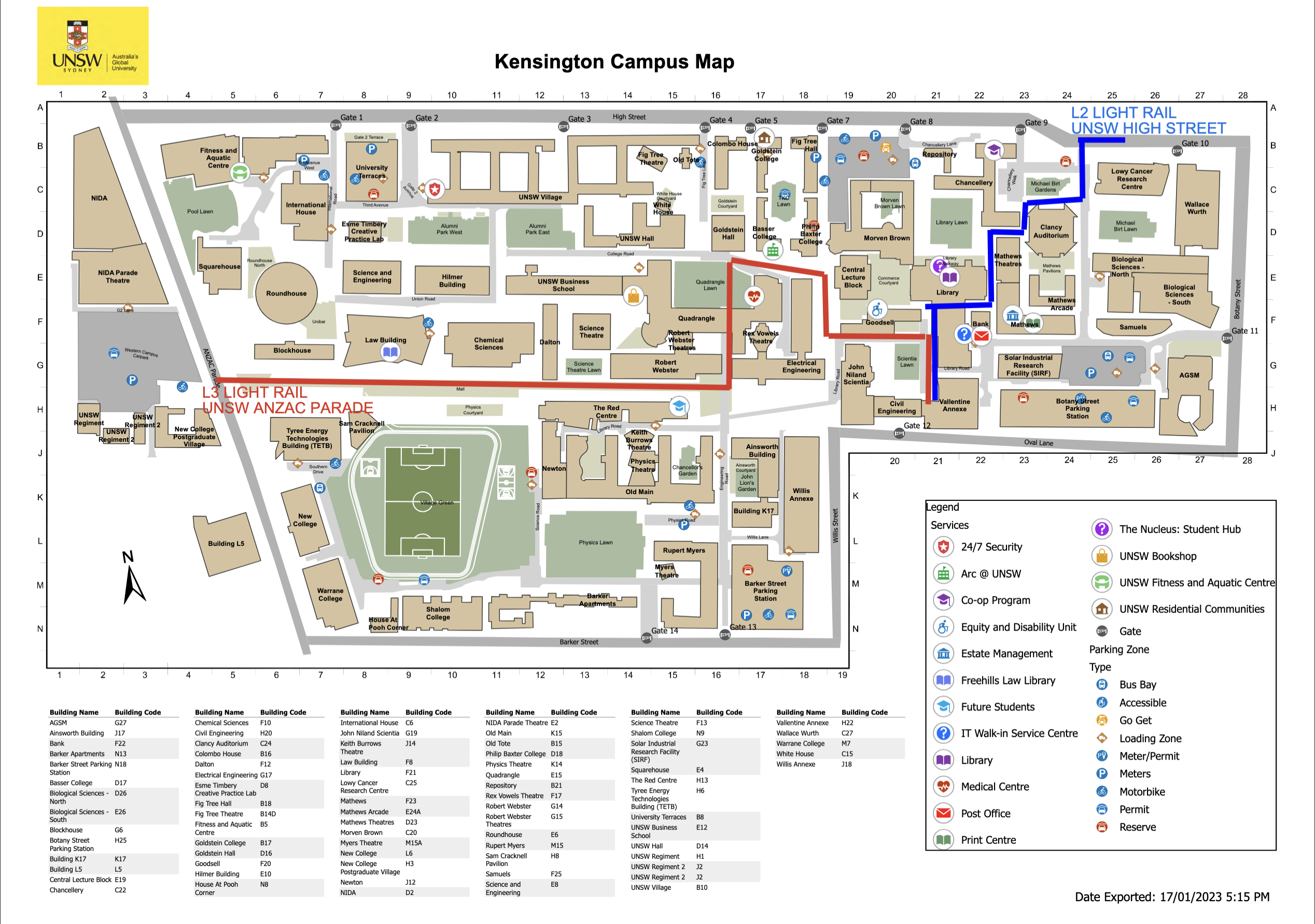
Registration opens at 08:30 on Saturday, 26 September 2026.
Address:
Civil Engineering Building (K-H20)
Lecture Theatre K-H20-G1
UNSW Sydney – Kensington Campus
High Street
Kensington NSW 2052, Australia
The following map shows
- 1 – The SPSC Symposium venue (Civil Engineering Building K-H20)
- 2 – The Interspeech 2026 venue (ICC Sydney)
- 3 – UNSW High Street Light Rail stop (L2 Randwick Line)
From marker 3, the symposium venue is only about a 4–5 minute walk.
How to reach?
- The easiest way to reach the venue is by Sydney Light Rail (L2 Randwick Line). Exit at UNSW High Street (Gate 9). From there it is approximately a 4–5 minute walk to the Civil Engineering Building (K-H20).
-
From ICC Sydney (Interspeech venue):
Take the L2 Randwick Light Rail (either directly or via Central Station) towards Randwick. Leave the tram at UNSW High Street and follow the signs to the Civil Engineering Building (K-H20). The journey typically takes 30–40 minutes. -
From Sydney City Centre / Central Station:
Take the L2 Randwick Light Rail towards Randwick and leave at UNSW High Street. The venue is about a 5 minute walk from the station. Travel time from Central Station is approximately 20–25 minutes. - Sydney's public transport accepts contactless credit/debit cards, Apple Pay, Google Pay and Opal cards, so no paper ticket is required.
- For additional travel information, please visit the UNSW Transport Information or explore the interactive campus map . Search for Building H20.
Organizing Committee
Ingo SIEGERT, Otto von Guericke University Magdeburg, Germany
Sneha DAS, Technical University of Denmark, Denmark
Brij Mohan Lal SRIVASTAVA, Co-founder and CEO of Nijta, France
Natalia TOMASHENKO, Inria, France
Xiaoxiao MIAO, Duke Kunshan University, China
Program Committee
(alphabetical)
Anna Leschanowsky — Fraunhofer Institute for Integrated Circuits (IIS), Germany
Brij Mohan Lal Srivastava — Nijta, France
Candy Olivia Mawalim — Japan Advanced Institute of Science and Technology, Japan
Ingo Siegert — Otto von Guericke University Magdeburg, Germany
Jean-Francois Bonastre — AMIAD & Université d’Avignon, France
Lin Zhang — Johns Hopkins University, United States
Liping Chen — University of Science and Technology of China, China
Longting Xu — Donghua University, China
Massimiliano Todisco — EURECOM, France
Michele Panariello — EURECOM, France
Natalia Tomashenko — Université de Lorraine, Loria, France
Nicholas Evans — EURECOM, France
Pierre Champion — The MAMA AI, Czechia
Rong Tong — Singapore Institute of Technology, Singapore
Sarina Meyer — University of Stuttgart, Germany
Sébastien Le Maguer — University of Helsinki, Finland
Sneha Das — Technical University of Denmark, Denmark
Thomas Thebaud — Johns Hopkins University, United States
Tom Bäckström — Aalto University, Finland
Wen-Chin Huang — Nagoya University, Japan
Xiaoxiao Miao — Duke Kunshan University, China
Xin Wang — National Institute of Informatics, Japan
Xuechen Liu — Xi'an Jiaotong-Liverpool University, China
You Zhang — University of Rochester, United States
Zexin Cai — Oracle, United States
Sponsors

The Microsoft CMT service was used for managing the peer-reviewing process for this conference. This service was provided for free by Microsoft and they bore all expenses, including costs for Azure cloud services as well as for software development and support.